YAG Laser Capsulotomy: Restoring Clear Vision After Cataract Surgery
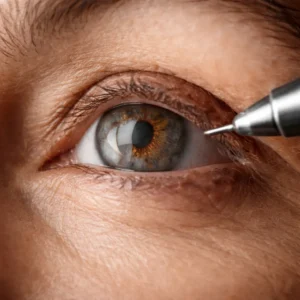
If you’ve previously undergone cataract surgery and are now experiencing cloudy or blurred vision once again, you’re not alone. This common occurrence affects approximately 20% of patients who have had cataract surgery, and fortunately, there’s a straightforward solution: YAG laser capsulotomy. At The Eye Dr Clinic, Mr Mohamed Mohyudin, our experienced Consultant Ophthalmic Surgeon, specialises in this quick, painless procedure that can restore your vision to clarity within hours.
What Is YAG Laser Capsulotomy?
YAG laser capsulotomy is a non-invasive laser procedure designed to treat posterior capsule opacification (PCO), often referred to as a “secondary cataract” or “after-cataract.” The term YAG refers to the Yttrium Aluminium Garnet laser used during the treatment, which is renowned for its precision and safety.
During your initial cataract surgery, your eye surgeon removed your cloudy natural lens and replaced it with a clear artificial intraocular lens (IOL). This new lens sits within your eye’s natural lens capsule—a thin, transparent membrane that holds the lens in place. Whilst the IOL itself remains clear, the capsule behind it can become cloudy over time, causing your vision to deteriorate despite the successful cataract surgery.
Understanding Posterior Capsule Opacification (PCO)
PCO can develop in up to 20% of patients within three years following cataract surgery. The condition occurs when residual lens cells left behind after your cataract operation begin to multiply and migrate across the posterior capsule. These cells form a cloudy membrane that obstructs light from passing through to your retina, resulting in symptoms similar to those you experienced with your original cataract.
Common symptoms of PCO include:
- Blurred or hazy vision
- Glare or halos around lights, particularly when driving at night
- Difficulty reading or performing close-up tasks
- Reduced contrast sensitivity
- A feeling that your cataract has “returned”
It’s important to understand that PCO is not a failure of your cataract surgery, nor is it a new cataract forming. Rather, it’s a natural healing response that can occur months or even years after your initial procedure.
The YAG Laser Capsulotomy Procedure
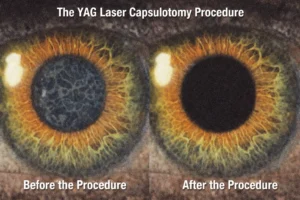
At The Eye Dr Clinic, we perform YAG laser capsulotomy as a straightforward outpatient procedure, typically completed in less than ten minutes. Here’s what you can expect:
Before the Procedure
Your consultant ophthalmologist will administer dilating eye drops to widen your pupils and anaesthetic drops to numb your eye completely. You won’t feel any pain or discomfort during the treatment. The preparation takes approximately 15-20 minutes as we wait for the drops to take full effect.
During the Treatment
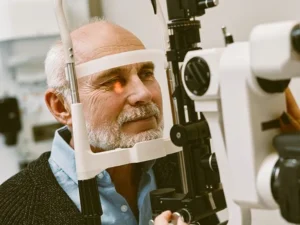
You’ll be seated comfortably at a specialised laser microscope called a slit lamp, similar to the equipment used during your regular eye examinations. Mr Mohyudin will use a special contact lens to focus the YAG laser precisely on the cloudy posterior capsule behind your IOL.
The laser delivers short, focused bursts of energy that create a small, circular opening in the clouded capsule. This opening allows light to pass through unobstructed, immediately restoring clear vision. The laser energy passes harmlessly through your cornea without making any incisions, eliminating the risk of infection associated with traditional surgery.
You’ll need to keep your eye focused on a fixed point whilst the laser works, and you may hear clicking sounds or see flashes of light. The entire laser treatment takes just five to ten minutes, though you may need to remain at the clinic for an hour or two afterwards for routine monitoring.
After the Procedure
Research demonstrates that between 83% and 96% of patients experience improvements in their vision following YAG laser capsulotomy. Many patients notice clearer vision immediately, whilst others see improvement within 24 hours as the dilating drops wear off.
Your ophthalmologist may prescribe anti-inflammatory eye drops to use for about a week following the procedure. It’s normal to notice some floaters in your vision for the first day or two—these typically settle down quickly and are nothing to worry about.
Benefits of YAG Laser Capsulotomy
YAG laser capsulotomy offers numerous advantages over traditional surgical approaches:
Quick and Convenient:
The procedure takes less than ten minutes, and you can return home the same day. Most patients resume normal activities immediately.
Painless:
Anesthetic drops ensure you won’t feel any discomfort during the treatment. Afterwards, you may experience mild soreness at most.
Highly Effective:
The success rate is exceptionally high, with the vast majority of patients experiencing significant visual improvement.
No Incisions:
The laser treatment requires no cuts or stitches, which means there’s no risk of surgical complications such as infection or wound healing issues.
Permanent Results:
YAG laser capsulotomy typically only needs to be performed once. The opening created in the capsule remains clear permanently, as the treated tissue cannot regenerate or cloud over again.
Minimal Recovery:
Unlike traditional surgery, there’s virtually no recovery period. Your vision should be clear within a day, and you can drive yourself home once the dilation wears off (though we recommend arranging transport on the day of the procedure).
Potential Risks and Complications
Whilst YAG laser capsulotomy is considered very safe, as with any medical procedure, there are some potential risks to be aware of:
Common Side Effects: You may notice an increase in floaters immediately after the procedure. These are usually temporary and diminish within a few days. Some patients experience slight changes in their glasses prescription.
Rare Complications: In very rare cases, patients may experience elevated eye pressure, inflammation, swelling of the retina (cystoid macular oedema), retinal tears, or retinal detachment. These complications occur in less than 1-2% of cases and are typically treatable when detected early.
If you experience any of the following symptoms after your procedure, contact us immediately or seek emergency eye care:
- Sudden increase in floaters or flashes of light
- A curtain or shadow across your vision
- Severe eye pain
- Significant vision loss
Who Needs YAG Laser Capsulotomy?
Not everyone who has had cataract surgery will develop PCO, but certain factors may increase your risk. You might be a candidate for YAG laser capsulotomy if you’ve previously undergone cataract surgery and are now experiencing:
- Progressive blurring of vision
- Difficulty with night driving due to glare
- Reduced ability to read or perform detailed tasks
- Visual symptoms similar to your original cataract
Your consultant ophthalmologist will conduct a comprehensive eye examination to determine whether PCO is causing your symptoms and whether YAG laser capsulotomy is the appropriate treatment.
When Can YAG Laser Capsulotomy Be Performed?
Doctors typically recommend waiting at least a few months following cataract surgery before considering YAG laser capsulotomy. This waiting period allows your eye to heal completely and adapt to the new intraocular lens. It also ensures that your symptoms aren’t simply part of the normal post-operative healing process.
PCO can develop at any time after cataract surgery from a few months to several years later. If you notice your vision deteriorating after initially improving following cataract surgery, it’s important to schedule an examination with your ophthalmologist promptly.
Why Choose The Eye Dr Clinic for YAG Laser Capsulotomy?
At The Eye Dr Clinic, Mr Mohamed Mohyudin provides exceptional, patient-centred eye care throughout West Yorkshire. As a Consultant Ophthalmic Surgeon registered with the General Medical Council, Mr Mohyudin (MBChB BSc MSc FRCOphth CCT) brings extensive experience and expertise to every procedure.
We utilise state-of-the-art laser technology and maintain the highest clinical standards to ensure optimal outcomes for our patients. Mr Mohyudin understands that experiencing vision problems after cataract surgery can be concerning, and he is committed to providing you with clear explanations, compassionate care, and effective treatment solutions.
From your initial consultation through to your follow-up care, you’ll receive personalised attention in a supportive environment. Mr Mohyudin takes the time to answer all your questions and ensures you feel confident and informed about your treatment.
Life After YAG Laser Capsulotomy
Following your YAG laser capsulotomy, you can look forward to restored clarity of vision and a return to your daily activities without visual limitations. Most patients are thrilled with their results and report significant improvements in their quality of life.
You’ll be able to:
- Read comfortably without struggling with blurred text
- Drive safely, both during the day and at night
- Enjoy hobbies and activities that require good vision
- Experience improved contrast and colour perception
It’s important to continue attending your regular eye examinations even after successful YAG laser capsulotomy. Routine eye care helps us monitor your overall eye health and detect any other conditions early.
Frequently Asked Questions About YAG Laser Capsulotomy
1. Is YAG laser capsulotomy painful?
No, YAG laser capsulotomy is not painful. Your eye is completely numbed with anaesthetic drops before the procedure begins, so you won’t feel any pain during the treatment. You might experience slight pressure from the contact lens used to focus the laser, but this is not uncomfortable. After the procedure, you may have mild soreness or grittiness, similar to having something in your eye, but this typically resolves within hours.
2. How long does it take to recover from YAG laser capsulotomy?
Recovery from YAG laser capsulotomy is remarkably quick. Many patients notice improved vision immediately after the procedure, though your eyes will remain dilated for several hours. Most people experience optimal vision within 24 hours. You can resume normal activities right away, though we recommend avoiding strenuous exercise for the first day and not driving until the dilation wears off completely (usually 4-6 hours).
3. Can posterior capsule opacification come back after YAG laser capsulotomy?
No, PCO cannot return after YAG laser capsulotomy. The laser creates a permanent opening in the posterior capsule, and the treated tissue cannot grow back or become cloudy again. This means you’ll only need the procedure once. However, it’s important to continue regular eye examinations, as other eye conditions unrelated to PCO can develop over time.
4. What is the success rate of YAG laser capsulotomy?
YAG laser capsulotomy has an excellent success rate. Studies show that 83-96% of patients experience significant improvement in their vision following the procedure, with some research reporting success rates as high as 99%. The procedure is considered the gold standard treatment for posterior capsule opacification, and complications are rare when performed by experienced ophthalmologists.
5. Will I need new glasses after YAG laser capsulotomy?
Some patients may experience minor changes in their glasses prescription after YAG laser capsulotomy, though this is not common. Any prescription changes are typically small. We recommend waiting at least four weeks after your procedure before having a full eye examination and glasses prescription update, as your vision may continue to stabilise during this period. Your ophthalmologist will advise you if new glasses are necessary during your follow-up appointment.
Your Vision Matters to Us
Schedule your comprehensive eye examination today and discover how we can help you see the world more clearly.
The Eye Dr Clinic offers expert YAG laser capsulotomy treatment at Spire Healthcare in Elland, Halifax. Mr Mohamed Mohyudin, our experienced Consultant Ophthalmic Surgeon, is dedicated to restoring your clear vision with the latest laser technology and personalised care. Contact us today to discuss your vision concerns and learn whether YAG laser capsulotomy is right for you.
For more information about our services or to book a consultation, call 01422 702 201 or email ellandhospppc@spirehealthcare.com.