
Floaters and Flashes: When to Worry About Eye Symptoms

Floaters are small specks or cobweb-like shapes drifting across vision, whilst flashes are brief streaks of light, both caused by changes in the vitreous gel inside the eye. Occasional, long-standing floaters are usually harmless. A sudden shower of new floaters, new flashes, or a shadow or curtain across vision can signal a retinal tear or detachment and requires same-day emergency assessment. The Eye Dr Clinic, Elland, Halifax offers same-day appointments for this exact scenario across West Yorkshire.
Seeing small dark specks drift across your vision, or brief flashes of light at the edge of your sight, is an experience most people encounter at some point in life. In many cases, floaters and flashes are a normal, harmless part of eye ageing. In other cases, however, they can be the first warning sign of a retinal tear or detachment a genuine eye emergency where prompt treatment makes the difference between preserved and permanently lost vision. At The Eye Dr Clinic in Elland, Halifax, Mr Mohamed Mohyudin MBChB BSc MSc FRCOphth CCT provides same-day emergency assessment of new floaters and flashes for patients across West Yorkshire, including Halifax, Huddersfield, Bradford, and Leeds.
Seek same-day emergency assessment if you notice:
- A sudden shower of new floaters, especially many appearing at once
- New flashes of light, particularly in your peripheral vision
- A dark curtain, shadow, or veil across part of your vision
- Any sudden reduction in your side (peripheral) vision
- These symptoms following recent eye trauma or previous eye surgery
Retinal detachment is time-critical. The sooner it is diagnosed and treated, the better the chance of preserving vision. If you notice any of the symptoms above, do not wait to see if they settle contact The Eye Dr Clinic immediately for same-day assessment.
What Are Floaters and Flashes?
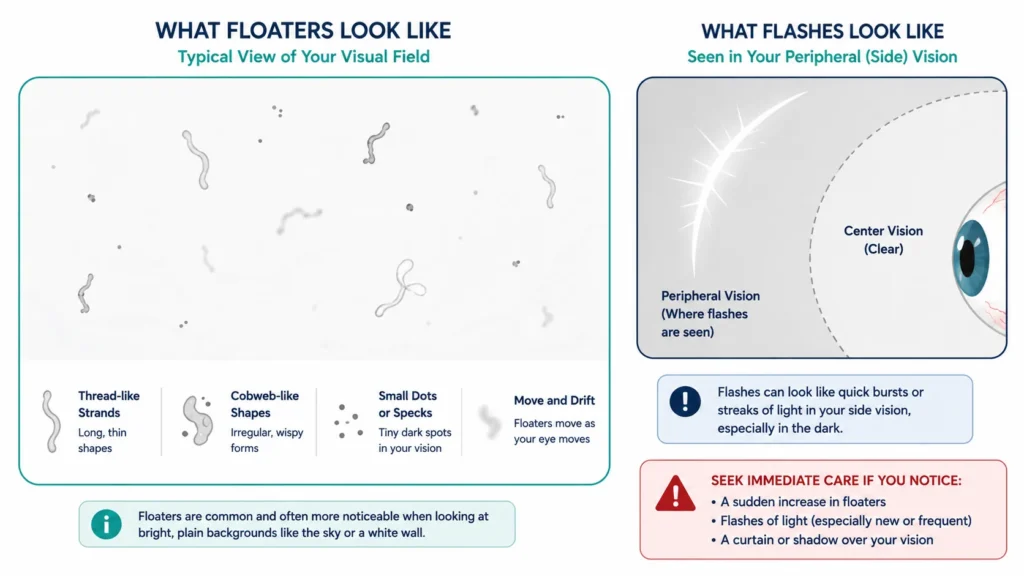
Floaters are small, often shadowy shapes specks, threads, cobwebs, or ring-like forms that appear to drift across your field of vision, particularly noticeable when looking at a plain bright background such as a clear sky or white wall. They are caused by tiny clumps of collagen fibres within the vitreous, the clear gel that fills the inside of the eye, casting shadows onto the retina as light passes through.
Flashes are brief streaks or flickers of light, often described as similar to a camera flash or lightning bolt, typically seen at the edge of vision. They occur when the vitreous gel tugs on the retina, mechanically stimulating it and creating the sensation of light even though no actual light is involved.
Why Do Floaters and Flashes Happen?
As we age, the vitreous gel inside the eye gradually becomes more liquid and can shrink slightly, eventually separating from the back surface of the eye in a process called posterior vitreous detachment (PVD). This is an extremely common, generally harmless part of ageing, usually occurring between the ages of 50 and 70, though it can happen earlier in short-sighted individuals.
The table below summarises the range of causes and the appropriate level of urgency for each pattern of symptoms.
Symptom Pattern | Likely Cause | Urgency |
A few floaters, stable for months/years | Normal age-related vitreous changes | Routine mention at next eye check |
Sudden shower of new floaters | Posterior vitreous detachment (PVD) | Assessment within 24 hours |
Flashes of light in peripheral vision | Vitreous tugging on the retina | Assessment within 24 hours |
Floaters/flashes with a curtain or shadow | Possible retinal detachment | Same-day emergency assessment |
Floaters after eye trauma or injury | Possible bleeding or retinal tear | Same-day emergency assessment |
Floaters with reduced central vision | Possible macular or vitreous haemorrhage | Same-day emergency assessment |
The critical distinction is between a stable, long-standing pattern of floaters which rarely needs urgent attention and any sudden change, new onset, or associated symptoms such as flashes or a shadow across vision, which always warrants prompt assessment.
Retinal Detachment: What You Need to Know
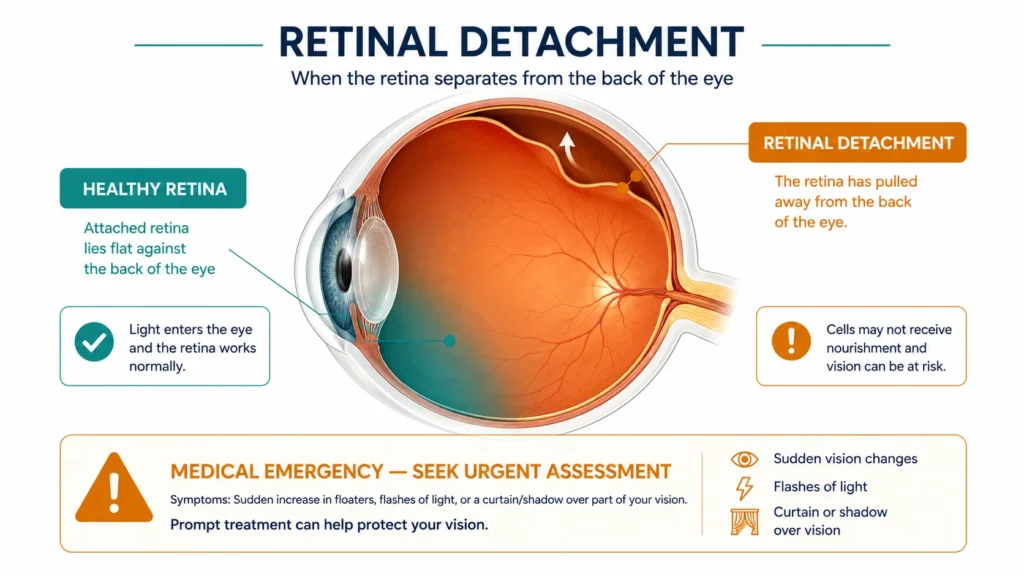
A retinal detachment occurs when the retina the light-sensitive layer at the back of the eye separates from the underlying tissue that supplies it with oxygen and nutrients. Without prompt treatment, the detached area loses its blood supply and stops functioning, resulting in permanent vision loss in that part of the eye.
Retinal detachment often begins with a retinal tear, frequently triggered by the same vitreous changes that cause posterior vitreous detachment. As fluid passes through the tear and separates the retina from the tissue behind it, patients typically notice a sudden shower of floaters, new flashes of light, and as detachment progresses a shadow or curtain effect spreading across part of their vision, often starting from one side.
Risk factors for retinal detachment include: short-sightedness (myopia), previous cataract surgery, previous retinal detachment in the other eye, a family history of retinal detachment, and previous significant eye trauma.
Why Same-Day Assessment Matters
Retinal detachment is a genuine ophthalmic emergency. The longer the retina remains detached particularly if the detachment involves the macula, the area responsible for central, detailed vision the greater the risk of permanent visual impairment even after successful surgical repair. This is why any sudden onset of floaters, flashes, or a shadow across vision should prompt same-day assessment rather than a routine appointment booked for a later date.
Diagnosis and Treatment for Floaters and Flashes
Assessment at The Eye Dr Clinic for new floaters or flashes includes a thorough dilated fundus examination, where drops are used to widen the pupil, allowing Mr Mohyudin to examine the entire retina in detail including the peripheral areas where tears most commonly occur.
Treatment depends entirely on the findings:
- Posterior vitreous detachment with no retinal tear: No treatment is usually needed. Floaters often become less noticeable over time as the brain adapts, though they rarely disappear completely.
- A retinal tear without detachment: Same-day laser treatment or cryotherapy can seal the tear and prevent progression to full retinal detachment.
- Retinal detachment: Urgent surgical repair is required, with the specific technique depending on the extent and location of the detachment. This is typically arranged as an emergency referral for same-day or next-day surgical treatment.
Floaters and flashes can also occasionally relate to other conditions requiring ongoing management, such as glaucoma, where changes in eye pressure and optic nerve health are monitored over time. Mr Mohyudin’s thorough assessment ensures any such underlying condition is identified alongside the primary symptom.
Why Choose The Eye Dr Clinic for Floaters and Flashes Assessment?
Genuine same-day emergency access. Retinal detachment is time-critical, and Mr Mohyudin prioritises same-day assessment for any patient presenting with sudden new floaters, flashes, or visual field loss.
Comprehensive retinal examination. A full dilated fundus examination allows detailed assessment of the peripheral retina, where tears most commonly develop and are easiest to miss without proper equipment and expertise.
Consultant-level expertise. As a Fellowship-qualified Consultant Ophthalmic Surgeon, Mr Mohyudin has extensive experience diagnosing and managing retinal emergencies, ensuring the correct treatment pathway is identified without delay.
Convenient access across West Yorkshire. The Eye Dr Clinic at Spire Healthcare, Elland is easily reached from Halifax, Huddersfield, Bradford, Leeds, and Wakefield, with free on-site parking.
For a full overview of all conditions treated, visit our Eye Specialist in Yorkshire page. If you are experiencing any of the warning symptoms described above, contact The Eye Dr Clinic immediately for same-day assessment.
Frequently Asked Questions About Floaters and Flashes
1) Are floaters normal, or should I always be concerned?
A small number of stable, long-standing floaters are common and usually harmless, particularly as part of normal ageing. However, any sudden increase in floaters, new flashes of light, or a shadow across your vision represents a change that should be assessed the same day, as these can be early signs of a retinal tear or detachment.
2) What do flashes of light in the eye actually look like?
Flashes are typically described as brief streaks, sparks, or flickers of light, often compared to lightning or a camera flash, and are usually seen at the edge (periphery) of vision. They occur when the vitreous gel tugs on the retina, most noticeable in dim lighting or when moving your eyes quickly.
3) How is retinal detachment treated?
Retinal detachment requires urgent surgical repair, with the technique depending on the size and location of the detachment. Options include laser treatment, cryotherapy, pneumatic retinopexy, vitrectomy, or scleral buckle surgery. Same-day or next-day treatment gives the best chance of restoring and preserving vision.
4) Can floaters and flashes go away on their own?
Floaters caused by normal vitreous changes often become less bothersome over time as the brain adapts, though the floaters themselves rarely disappear completely. However, floaters and flashes caused by a retinal tear will not resolve on their own and require prompt treatment to prevent progression to retinal detachment.
5) How quickly can I be seen for sudden floaters or flashes in Yorkshire?
Call 01422 702 201 immediately if you notice sudden new floaters, flashes, or a shadow across your vision. Mr Mohyudin offers same-day emergency assessment at The Eye Dr Clinic, Elland, Halifax, for patients across West Yorkshire presenting with these symptoms.
Your Vision Matters to Us
New floaters and flashes are not something to monitor and wait on. A same-day assessment gives Mr Mohyudin the best opportunity to identify any retinal tear or detachment early, when treatment is most effective at preserving your sight.
Notice New Floaters or Flashes? Book Same-Day Assessment
Book Your Emergency Appointment at The Eye Dr Clinic
Same-day emergency appointments available. Serving Halifax, Huddersfield, Bradford, Leeds and across West Yorkshire.
For more information or to book an urgent assessment, call 01422 702 201 or email ellandhospppc@spirehealthcare.com.