Driving Eyesight Standards: What the Law Requires in the UK (2026)
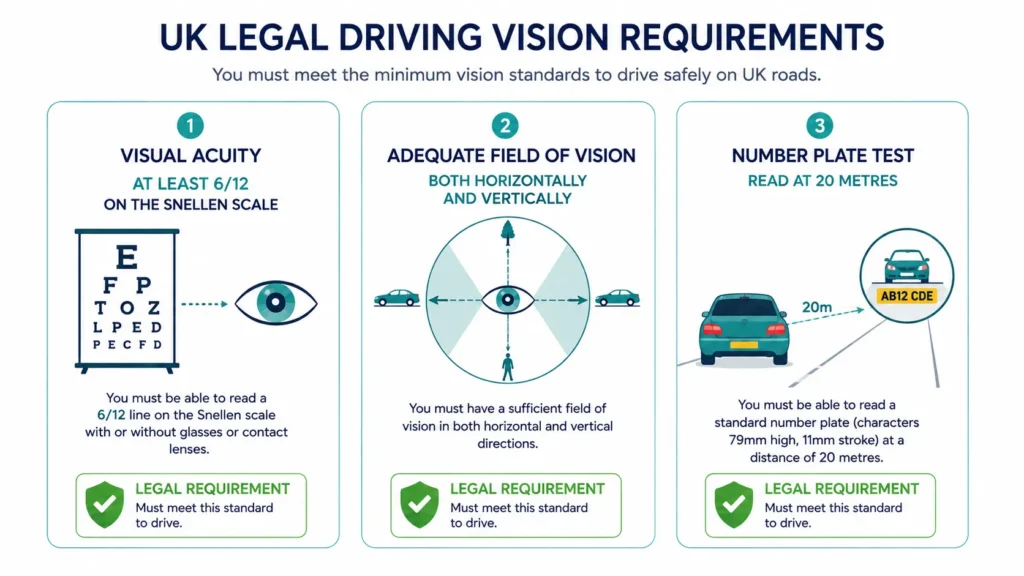
To drive legally in the UK in 2026, you must be able to read a car number plate from 20 metres in good daylight, achieve a visual acuity of at least 0.5 (6/12) on the Snellen scale using both eyes together, and have a visual field of at least 120 degrees. These standards apply whether or not you wear glasses or contact lenses, provided they are worn while driving. If you have any doubt about meeting these standards, a full eye assessment at The Eye Dr Clinic, Elland, Halifax can confirm your fitness to drive.
Good eyesight is fundamental to safe driving, and UK law sets out clear minimum standards that every driver must meet. Yet many people are unsure exactly what these driving eyesight test standards require, or whether their own vision would pass if formally assessed. Understanding the legal requirements and getting your eyes properly checked if you have any doubts is a straightforward way to protect yourself, your passengers, and other road users. At The Eye Dr Clinic in Elland, Halifax, Mr Mohamed Mohyudin MBChB BSc MSc FRCOphth CCT provides thorough eyesight assessments for driving standards, serving patients across West Yorkshire including Halifax, Huddersfield, Bradford, and Leeds.
UK Driving Eyesight Standards Explained
The Driver and Vehicle Licensing Agency (DVLA) sets the legal minimum eyesight standards for driving in the UK. These standards are designed to ensure every driver has sufficient central vision, peripheral awareness, and visual clarity to react safely to hazards on the road.
Requirement | UK Legal Standard |
Number plate test | Read a car number plate (post-2001 format) from 20 metres, in good daylight, with glasses or contact lenses if worn |
Visual acuity | At least 0.5 (6/12) on the Snellen scale, using both eyes together (or one eye if you only have vision in one) |
Visual field | A field of at least 120 degrees horizontally, with no significant defect within the central 20 degrees |
Double vision | Must be well controlled or corrected before driving; uncontrolled double vision does not meet the standard |
Night vision / glare | No specific test, but you must be confident you can drive safely after dark and in poor weather |
These standards apply to standard car and motorcycle licences (Group 1). Higher standards apply for bus, coach, and lorry drivers (Group 2 licences), including stricter visual acuity requirements and additional restrictions around monocular vision (sight in only one eye).
The Number Plate Test: A Simple Self-Check
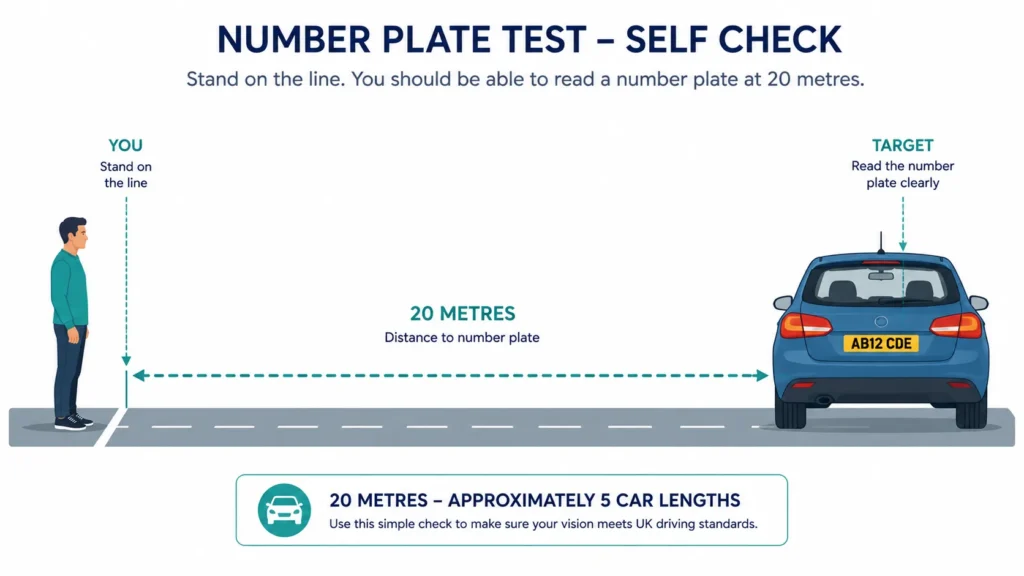
The number plate test is the quickest way to get an initial sense of whether your vision meets UK legal standards. From a distance of 20 metres roughly five car lengths you should be able to read a standard-format number plate (post-September 2001 style) in good daylight, wearing glasses or contact lenses if you normally use them for driving.
If you struggle to read a number plate clearly at this distance, this is a strong signal that your vision may not currently meet the legal standard for driving, and a full eye assessment should be arranged promptly. The number plate test is a useful rule of thumb, but it is not a substitute for a formal visual acuity and visual field assessment, which measures your vision far more precisely.
Eye Conditions That Can Affect Your Fitness to Drive
A number of common eye conditions can gradually or suddenly affect vision to the point where the legal driving standard is no longer met. Recognising these is important, since deteriorating vision is not always obvious to the person experiencing it.
- Cataracts: Progressive clouding of the natural lens gradually reduces visual acuity and increases glare sensitivity, particularly affecting night driving well before the legal standard is breached
- Glaucoma: Can cause gradual loss of peripheral vision, often unnoticed until relatively advanced, directly affecting the visual field requirement
- Macular degeneration: Primarily affects central vision, impacting the ability to read number plates and road signs clearly
- Diabetic retinopathy: Can cause both central and peripheral visual disturbance if blood sugar control has affected the retina
- Uncorrected refractive error: Simply needing an updated glasses prescription can be enough to fall below the legal standard
If you have been diagnosed with any of these conditions, or suspect your vision may have changed, it is your legal responsibility to inform the DVLA and ensure your eyesight is formally assessed. Our Cataract Surgery Yorkshire guide and Blurred Vision guide cover two of the most common causes of declining driving vision in detail.
Your Legal Responsibility as a Driver
It is a legal requirement in the UK to meet the eyesight standard for driving at all times you are behind the wheel, not just at the point you passed your driving test. You must notify the DVLA if you develop an eyesight condition that could affect your ability to drive safely, and the police have the power to require a roadside eyesight test including the number plate test at any time.
Driving with vision that does not meet the legal standard can invalidate your insurance, result in fines and penalty points, and in the event of an accident, carries potentially serious legal consequences. It also, most importantly, places you and others at real risk of harm.
Practical checklist: Should you book an eyesight assessment?
- You struggle with the number plate test at 20 metres, even wearing your usual glasses
- You have noticed increased glare or haloes around headlights when driving at night
- Your last full eye examination was more than two years ago
- You have been told you have cataracts, glaucoma, or diabetic eye changes
- You have noticed any gradual or sudden change in your vision
Eyesight Assessment for Driving at The Eye Dr Clinic
Mr Mohyudin provides comprehensive eye assessments that go well beyond a basic sight test, including formal visual acuity measurement, visual field testing, and a full examination for any underlying eye condition that could affect your fitness to drive such as cataracts, glaucoma, or retinal changes.
If your assessment identifies a treatable cause of reduced vision, such as cataracts, appropriate treatment can often restore your vision fully to a level well above the legal driving standard. Mr Mohyudin will discuss your results clearly and advise on the appropriate next steps, including whether you need to notify the DVLA.
For a full overview of all conditions treated, visit our Eye Specialist in Yorkshire page. To learn more about Mr Mohyudin’s background, see the About Mr Mohyudin page.
Frequently Asked Questions About Driving Eyesight Standards in the UK
1) What is the minimum eyesight standard to drive in the UK?
You must be able to read a car number plate from 20 metres in good daylight and achieve a visual acuity of at least 0.5 (6/12) on the Snellen scale using both eyes together, with a visual field of at least 120 degrees. These standards can be met with glasses or contact lenses if you wear them while driving.
2) Do I need to tell the DVLA if my eyesight gets worse?
Yes. You are legally required to notify the DVLA if you develop an eyesight condition that could affect your ability to drive safely, such as significant cataracts, glaucoma, or any condition affecting your visual field. Failing to do so can invalidate your insurance and carries legal consequences.
3) Can I drive with vision in only one eye?
Many people with vision in only one eye can still meet the legal standard for a standard car licence, provided the seeing eye meets the required visual acuity and field standards. However, stricter rules apply for vocational (Group 2) licences such as bus and lorry driving, and a formal medical assessment is usually required.
4) How often should I have my eyes tested if I drive regularly?
A full eye examination every two years is generally recommended for adults, though this may be more frequent if you have an existing eye condition, are over 60, or have noticed any change in your vision. Regular checks help identify gradual changes, such as early cataracts, before they affect your driving safety.
5) Where can I get a driving eyesight assessment in Yorkshire?
Call 01422 702 201 or book online to arrange a comprehensive eyesight assessment with Mr Mohyudin at The Eye Dr Clinic, Elland, Halifax. Appointments are typically available within 1-2 weeks for patients across West Yorkshire including Halifax, Huddersfield, Bradford, and Leeds.
Your Vision Matters to Us
Meeting the legal eyesight standard for driving is about more than avoiding a fine it is about ensuring you, your passengers, and everyone else on the road stays safe. If you have any doubt about your vision, a thorough assessment gives you clarity and, where needed, a clear path to treatment.
Book Your Driving Eyesight Assessment in Yorkshire
Book Your Appointment at The Eye Dr Clinic
Appointments within 1-2 weeks. Serving Halifax, Huddersfield, Bradford, Leeds and across West Yorkshire.