Astigmatism Treatment Yorkshire: Correcting Blurred and Distorted Vision
Astigmatism occurs when the cornea or lens has an irregular, football-shaped curve rather than a perfectly round one, causing blurred or distorted vision at all distances. It is corrected with glasses, toric contact lenses, or for patients also having cataract surgery a toric intraocular lens (IOL) that corrects the astigmatism permanently at the same time. Toric IOLs at The Eye Dr Clinic, Elland, Halifax cost from £2,800 per eye. Appointments typically available within 1-2 weeks.
Astigmatism is one of the most common refractive conditions affecting vision, present to some degree in almost half of the adult population. Unlike short or long sight, astigmatism causes vision to appear blurred or stretched at all distances, rather than only near or far. Fortunately, astigmatism treatment is highly effective, ranging from simple glasses to permanent surgical correction. At The Eye Dr Clinic in Elland, Halifax, Mr Mohamed Mohyudin MBChB BSc MSc FRCOphth CCT provides expert astigmatism assessment and treatment, including toric lens options during cataract surgery, for patients across West Yorkshire including Halifax, Huddersfield, Bradford, and Leeds.
What Is Astigmatism?
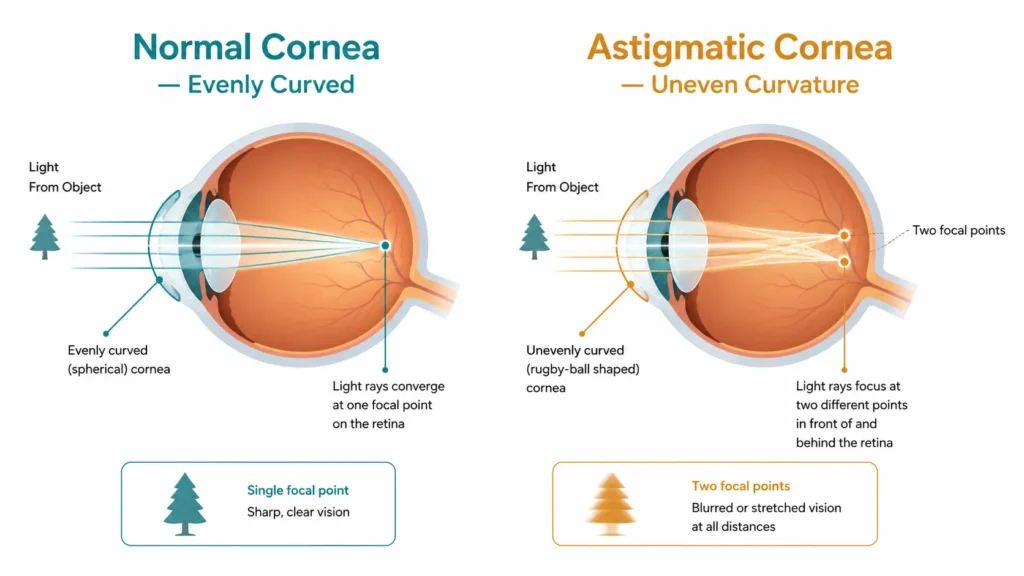
In a normally shaped eye, the cornea and lens are evenly curved, like the surface of a football, focusing light to a single sharp point on the retina. In an eye with astigmatism, the cornea or lens is more oval or rugby-ball shaped, curving more steeply in one direction than the other. This causes light to focus at two separate points rather than one, resulting in blurred or distorted vision at every distance.
Astigmatism is not an eye disease it is a common refractive variation in eye shape, present from birth in most cases, though it can also develop or change following eye surgery, injury, or conditions such as keratoconus. It frequently occurs alongside short-sightedness (myopia) or long-sightedness (hyperopia).
Common Symptoms of Astigmatism
- Blurred or distorted vision at both near and far distances, rather than one or the other
- Streaking or shadowing around lights, particularly noticeable when driving at night
- Eye strain and headaches, especially after reading or screen use, as the eye works harder to compensate
- Squinting to try to bring objects into sharper focus
- Difficulty with fine detail at any distance, such as reading small text or road signs
How Astigmatism Is Diagnosed
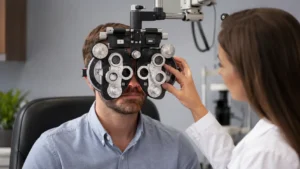
Astigmatism is diagnosed through a comprehensive eye examination, including corneal topography a detailed mapping of the corneal surface that precisely measures the degree and orientation (axis) of any irregular curvature. This mapping is essential not only for prescribing glasses or contact lenses, but also for planning toric IOL surgery with the highest possible accuracy.
At The Eye Dr Clinic, Mr Mohyudin uses state-of-the-art 2026 biometry and topography equipment to assess astigmatism precisely, ensuring any recommended correction whether glasses, contact lenses, or a toric lens implant is calculated to the correct power and axis for your individual eye.
Astigmatism Treatment Options in Yorkshire
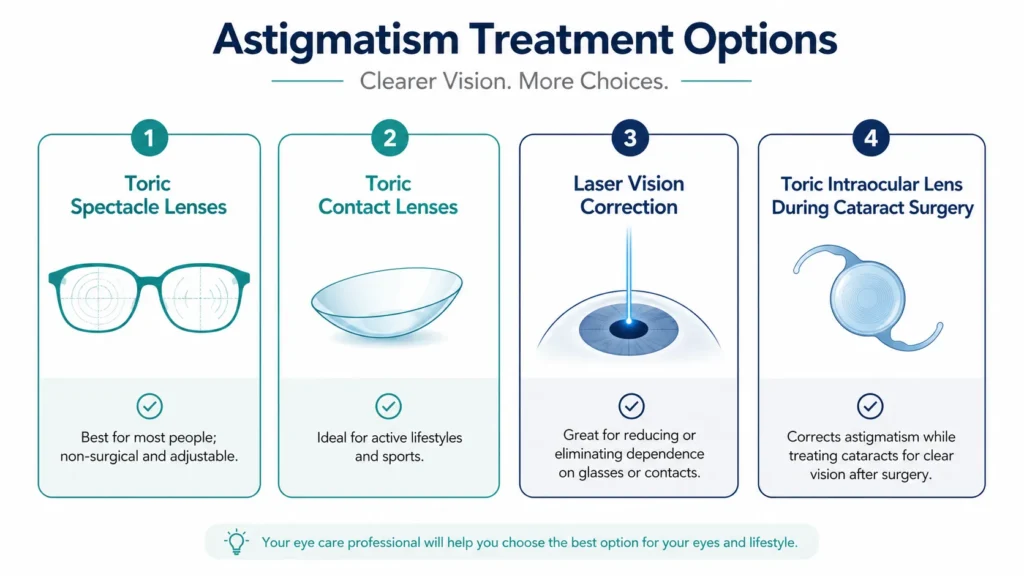
Treatment for astigmatism depends on its severity, your lifestyle, and whether you are also undergoing cataract surgery. The table below summarises the main options available.
| Treatment | Best Suited For | Key Consideration |
| Glasses (cylindrical lenses) | Any degree of astigmatism, all ages | Simple, adjustable, no procedure required |
| Toric contact lenses | Patients preferring lens wear over glasses | Requires consistent lens orientation for clear vision |
| Toric IOL (during cataract surgery) | Patients with astigmatism undergoing cataract surgery | Corrects astigmatism permanently at the same time as cataract removal |
| Laser refractive surgery (LASIK/PRK) | Younger patients without cataracts, stable prescription | Not offered at The Eye Dr Clinic referral available if appropriate |
For most patients without cataracts, glasses remain the simplest and most flexible option, easily adjusted as your prescription changes over time. Contact lenses suit those who prefer not to wear glasses day-to-day, though toric lenses require a stable orientation on the eye to work effectively, which can take some initial adjustment.
Toric Intraocular Lenses: Correcting Astigmatism During Cataract Surgery
For patients with astigmatism who are also developing cataracts, a toric intraocular lens (IOL) offers a particularly efficient solution correcting both the cataract and the astigmatism in a single procedure, rather than continuing to rely on glasses afterwards.
A standard monofocal lens used in cataract surgery corrects short or long sight but does nothing for astigmatism, meaning patients with significant astigmatism would still need glasses for clear vision after standard cataract surgery. A toric IOL, by contrast, is specifically shaped to counteract the eye’s irregular curvature, correcting the astigmatism at the same time the cloudy natural lens is replaced.
This is one of the most valuable premium lens upgrades available at The Eye Dr Clinic, and Mr Mohyudin routinely discusses toric lens suitability with any cataract patient who has a measurable degree of corneal astigmatism. For a full comparison of premium lens options, see our premium vs standard cataract surgery guide.
Already booked for cataract surgery? Ask about toric lenses
- If you have astigmatism and are also having cataract surgery, a toric IOL can correct both issues in one procedure
- Precisely calculated using corneal topography for your individual eye
- Significantly reduces or eliminates the need for glasses for distance vision after surgery
- Discussed as standard during your cataract consultation with Mr Mohyudin
See our full cataract surgery guide for further detail
To learn more about the cataract procedure itself, visit our Cataract Surgery Yorkshire complete guide.
Why Choose The Eye Dr Clinic for Astigmatism Treatment in Yorkshire?
Precision diagnostic technology. Accurate correction of astigmatism depends on precise measurement. Mr Mohyudin’s state-of-the-art 2026 corneal topography equipment ensures every toric lens is calculated to the correct power and axis.
Combined expertise. As a Consultant Ophthalmic Surgeon with Fellowship of the Royal College of Ophthalmologists, Mr Mohyudin has extensive experience integrating astigmatism correction into cataract surgery planning, maximising the visual benefit of your procedure.
Transparent guidance. Not every patient needs or benefits from a toric lens. Mr Mohyudin will assess your degree of astigmatism honestly and advise whether the additional investment in a toric IOL is likely to be worthwhile for your specific eyes.
Convenient access. The Eye Dr Clinic at Spire Healthcare, Elland is easily reached from Halifax, Huddersfield, Bradford, Leeds, and Wakefield, with appointments typically available within 1-2 weeks.
Frequently Asked Questions About Astigmatism Treatment in Yorkshire
1) Can astigmatism be corrected permanently?
Yes. A toric intraocular lens implanted during cataract surgery provides a permanent correction of astigmatism, as it replaces the eye’s natural lens with a precisely shaped artificial one. For patients not undergoing cataract surgery, laser refractive surgery can also permanently reshape the cornea, though this is not offered directly at The Eye Dr Clinic.
2) Do I need a toric lens if I have astigmatism and am having cataract surgery?
Not necessarily it depends on the degree of astigmatism present. Mild astigmatism may have minimal impact on vision after standard cataract surgery, whilst moderate to significant astigmatism benefits considerably from toric lens correction. Mr Mohyudin will assess your individual case and advise honestly on whether a toric lens is worthwhile.
3) Will astigmatism get worse over time?
Astigmatism is usually stable throughout adulthood, though gradual changes can occur, particularly as cataracts develop and alter the shape or clarity of the natural lens. Certain conditions, such as keratoconus, can cause progressive astigmatism and require separate specialist management.
4) Can I wear normal contact lenses if I have astigmatism?
Standard spherical contact lenses do not correct astigmatism effectively. Toric contact lenses are specifically designed with different powers in different meridians of the lens and must maintain a consistent orientation on the eye to provide clear vision throughout the day.
5) How do I get astigmatism treatment in Yorkshire?
Call 01422 702 201 or book online to arrange a consultation with Mr Mohyudin at The Eye Dr Clinic, Elland, Halifax. A detailed assessment including corneal topography will determine the most suitable correction for your individual eyes, whether glasses, contact lenses, or toric lens surgery.
Your Vision Matters to Us
Whether you are managing astigmatism with glasses or considering a toric lens as part of cataract surgery, Mr Mohyudin will ensure your correction is calculated with precision and explained clearly, so you understand exactly what to expect from your vision afterwards.
Book Your Astigmatism Assessment in Yorkshire
Book Your Appointment at The Eye Dr Clinic
Appointments within 1-2 weeks. Serving Halifax, Huddersfield, Bradford, Leeds and across West Yorkshire.