Dry Eyes Treatment Yorkshire: Expert Relief from Chronic Discomfort in 2026

Dry eyes occur when the eye does not produce enough tears, or when tears evaporate too quickly, leaving the ocular surface inadequately lubricated. In 2026, treatment options range from lubricating drops and lid hygiene for mild cases to prescription ciclosporin drops, punctal plugs. Mr Mohyudin at The Eye Dr Clinic, Elland, Halifax offers specialist dry eye assessment and the full range of treatments. Private appointments available within 1–2 weeks.
Dry eyes affect an estimated 1 in 4 adults in the UK, making it one of the most common and most frequently undertreated eye conditions seen in clinical practice. The symptoms range from a persistent scratchy sensation and intermittent blurred vision to significant daily discomfort that affects work, driving, and quality of life. If you have been managing dry eyes with over-the-counter drops without lasting relief, a specialist assessment is the appropriate next step. At The Eye Dr Clinic in Elland, Halifax, Mr Mohamed Mohyudin MBChB BSc MSc FRCOphth CCT provides expert dry eye diagnosis and treatment for patients across West Yorkshire, including Halifax, Huddersfield, Bradford, Leeds, Wakefield, and Brighouse.
What Are Dry Eyes and What Causes Them?
Dry eye syndrome clinically known as keratoconjunctivitis sicca occurs when the eye’s tear film is insufficient to maintain a stable, comfortable ocular surface. The tear film is a complex three-layer structure: an outer oily layer produced by the meibomian glands of the eyelids, a middle aqueous (watery) layer from the lacrimal gland, and an inner mucin layer from the conjunctiva.
Disruption to any of these layers can produce dry eye symptoms. The most common cause in 2026 is meibomian gland dysfunction (MGD) a blockage or dysfunction of the oil-producing glands along the eyelid margin which leads to rapid evaporation of the tear film. This accounts for approximately 85% of dry eye cases.
Common Causes of Dry Eyes
- Meibomian gland dysfunction (MGD): Blocked or dysfunctional lid glands reduce the oily layer, accelerating tear evaporation
- Blepharitis: Chronic inflammation of the eyelid margins, often linked to MGD and bacterial overgrowth
- Age: Tear production naturally declines with age; dry eye is more prevalent in the over-50s
- Screen use: Reduced blink rate during prolonged computer or phone use allows tears to evaporate more rapidly
- Contact lens wear: Lenses can disrupt the tear film and reduce corneal sensitivity over time
- Medications: Antihistamines, antidepressants, beta-blockers, and HRT can all reduce tear production
- Environment: Air conditioning, central heating, and low humidity — common in Yorkshire offices and homes during winter — accelerate evaporation
- Hormonal changes: Particularly in women during menopause, when androgen levels affecting meibomian gland function decline
- Previous eye surgery: LASIK and cataract surgery can temporarily reduce corneal nerve sensitivity, affecting tear reflex
Recognising Dry Eye Symptoms
Dry eye symptoms are often dismissed as tiredness or minor irritation. Recognising the pattern is important for seeking appropriate care early, before the condition becomes chronic and more difficult to manage.
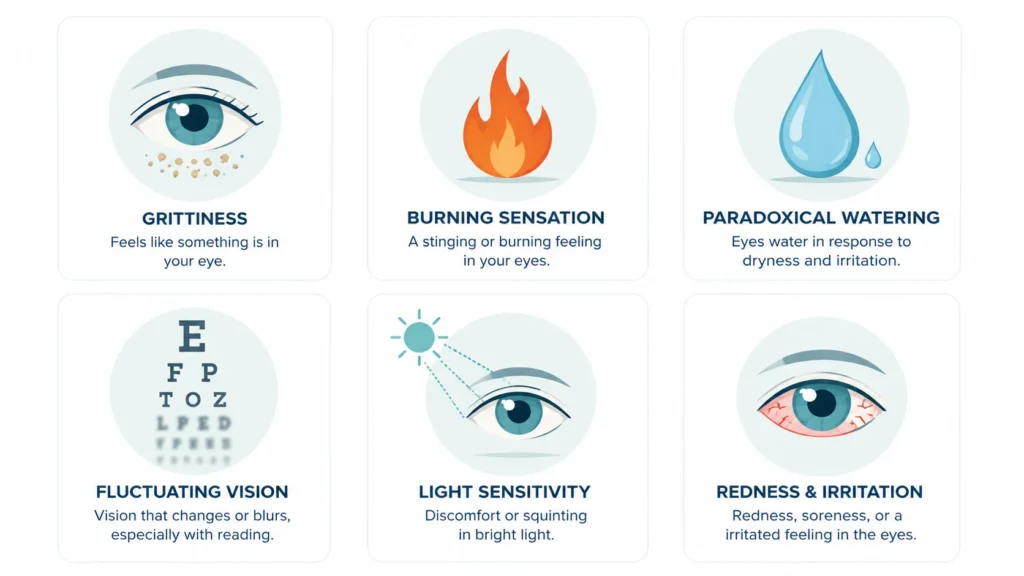
Common symptoms of dry eye syndrome include:
- A persistent gritty, scratchy, or burning sensation in one or both eyes
- Intermittent blurred vision that temporarily clears with blinking
- Red, irritated eyes, particularly in the evenings or after screen use
- Stinging or sensitivity to wind, smoke, or air conditioning
- Paradoxical watery eyes — reflex tearing in response to an unstable tear film
- Discomfort or difficulty wearing contact lenses
- Eye fatigue after reading, driving, or using screens
If symptoms are persistent — present on most days for three months or more — or significantly affect daily activities, a specialist dry eye assessment at The Eye Dr Clinic is recommended rather than continued self-management with drops alone.
How Is Dry Eye Diagnosed at The Eye Dr Clinic?
Accurate diagnosis is essential before any treatment plan is recommended. Many patients arrive at The Eye Dr Clinic having used lubricating drops for months or years without meaningful improvement, often because the underlying cause has not been properly identified.
Mr Mohyudin’s dry eye assessment includes:
- Slit-lamp examination: Detailed examination of the ocular surface, tear film, lid margins, and meibomian glands
- Tear film assessment: Measurement of tear break-up time (TBUT) to identify film instability
- Corneal staining: Fluorescein and rose bengal dyes highlight areas of ocular surface damage
- Meibomian gland evaluation: Assessment of gland expressibility and secretion quality
- Schirmer’s test (where indicated): Measures aqueous tear production using a small absorbent strip
This thorough approach identifies whether the dry eye is primarily evaporative (MGD-driven), aqueous-deficient, or a combination of both — which directly determines which treatment pathway will be most effective for you.
Dry Eye Treatment Options in Yorkshire
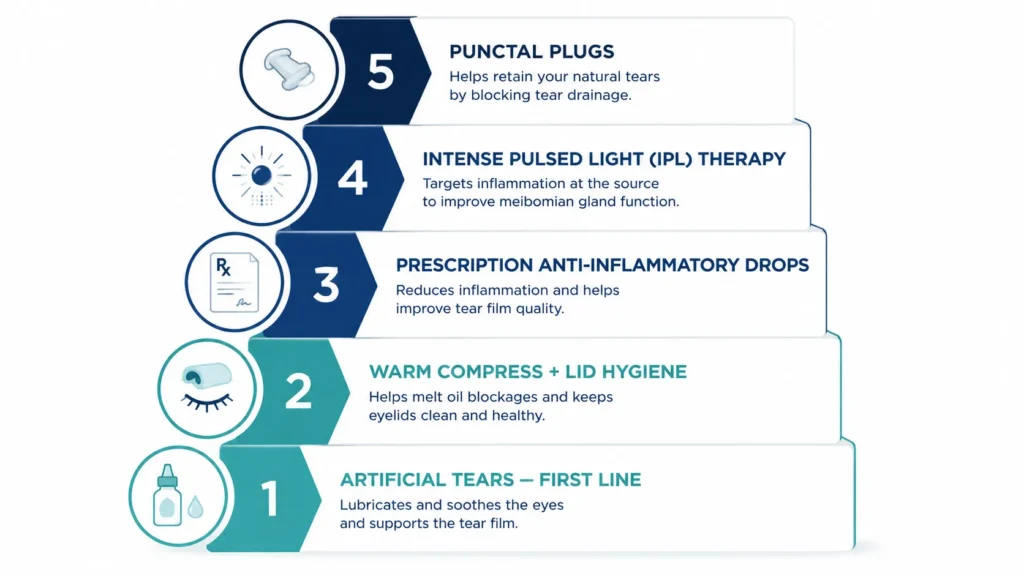
Treatment for dry eyes is most effective when matched to the underlying cause and severity. The table below outlines the main options available, from first-line self-care measures to specialist clinic treatments.
| Treatment | Best For | How It Works | Where Available |
| Lubricating eye drops | Mild dry eye, occasional symptoms | Replaces or supplements the tear film | Pharmacy / GP |
| Warm compresses & lid hygiene | Meibomian gland dysfunction (MGD) | Unblocks oil glands along the lid margin | Home / clinic guidance |
| Omega-3 supplementation | Mild to moderate MGD | Reduces inflammation, improves oil layer | Pharmacy |
| Prescription drops (e.g. ciclosporin) | Moderate to severe dry eye | Reduces ocular surface inflammation | Specialist / GP |
| Punctal plugs | Moderate dry eye with rapid tear drainage | Slows drainage to keep tears on the eye surface | Specialist clinic |
Mr Mohyudin tailors every treatment plan to the individual patient’s diagnosis, symptom severity, and lifestyle. For patients with moderate to severe MGD who have not responded to drops and warm compresses.
First-Line Dry Eye Management
For mild to moderate dry eye, a structured self-management programme forms the foundation of treatment:
- Preservative-free lubricating drops: Used regularly throughout the day (not just when symptoms flare), these are the cornerstone of dry eye management. Preservative-free formulations minimise additional ocular surface irritation from preservatives
- Warm compresses: Applied to closed lids for 10 minutes twice daily, heat softens the blocked meibomian gland secretions, improving oil flow and tear film stability
- Lid hygiene: Gentle cleaning of the lid margins removes blepharitis-associated debris and biofilm that contributes to gland dysfunction
- Omega-3 supplementation: High-dose omega-3 fatty acids (EPA and DHA) support meibomian gland function and reduce ocular surface inflammation in MGD
Specialist Dry Eye Treatments at The Eye Dr Clinic
Prescription ciclosporin drops are recommended for patients with moderate to severe dry eye where inflammation is a significant component. Ciclosporin suppresses the immune-mediated inflammation of the lacrimal gland and ocular surface, increasing natural tear production over time. Results typically become evident after 3–6 months of consistent use.
Punctal plugs are tiny, biocompatible devices inserted into the puncta — the small drainage openings at the inner corner of the upper and lower eyelids. By slowing tear drainage, punctal plugs increase the volume of tears available on the ocular surface. The procedure is quick, painless, and reversible.
The Connection Between Dry Eyes and Eyelid Health
Dry eye and eyelid disease are closely linked. Blepharitis — chronic inflammation of the eyelid margins — is one of the most common contributing factors to meibomian gland dysfunction and dry eye syndrome. Patients with blepharitis often present with symptoms indistinguishable from straightforward dry eye, and treating the lids is essential to improving the tear film.
Mr Mohyudin’s oculoplastic expertise means that eyelid-related causes of dry eye — including ectropion (outward-turning lower lid), entropion (inward-turning lower lid), and incomplete lid closure — are identified and addressed as part of the overall dry eye management plan. These conditions are described in more detail on our eyelid surgery page.
Patients considering or recovering from blepharoplasty surgery are also assessed for pre-existing dry eye, as optimising the ocular surface before and after eyelid surgery is an important part of safe surgical planning.
Why Choose The Eye Dr Clinic for Dry Eye Treatment in Yorkshire?
Many patients with chronic dry eyes have seen their GP or visited a high-street optician and been given lubricating drops without significant improvement. A specialist assessment with Mr Mohyudin goes considerably further.
Specialist-level diagnosis. Mr Mohyudin performs a detailed slit-lamp assessment of the tear film, lid margins, and ocular surface — not a brief screening. This identifies the specific subtype of dry eye driving your symptoms and directs treatment accordingly.
Full treatment pathway. From first-line drops and lid hygiene guidance to prescription drops, punctal plugs, The Eye Dr Clinic provides access to the complete range of evidence-based dry eye treatments under one roof.
Integrated eyelid and ocular surface expertise. Mr Mohyudin’s combined ophthalmology and oculoplastic background means that eyelid structural causes of dry eye — often missed in standard assessments — are identified and treated.
Rapid access. Private appointments at The Eye Dr Clinic are available within 1–2 weeks, compared with typical NHS waiting times of 3–6 months for a hospital ophthalmology appointment. Patients travel from across West Yorkshire, including Halifax, Huddersfield, Bradford, Leeds, Wakefield, and Dewsbury.
For an overview of all eye conditions and treatments available, visit our eye conditions and treatments page. To learn about Mr Mohyudin’s background and qualifications, see the About Mr Mohyudin page.
At a glance: Dry Eye Treatment at The Eye Dr Clinic
- Specialist slit-lamp dry eye assessment — not a basic screening
- Full treatment range: drops, lid hygiene, ciclosporin, punctal plugs.
- Integrated eyelid and ocular surface expertise
- Appointments available within 1–2 weeks across West Yorkshire
GMC registered Consultant Ophthalmic Surgeon — Mr Mohamed Mohyudin FRCOphth CCT
Frequently Asked Questions About Dry Eyes Treatment in Yorkshire
1) What is the most effective treatment for dry eyes in 2026?
The most effective treatment depends on the underlying cause and severity. For mild to moderate dry eye, preservative-free lubricating drops combined with warm compresses and lid hygiene address the majority of cases. For moderate to severe meibomian gland dysfunction, Mr Mohyudin will determine the most appropriate plan following a detailed assessment at The Eye Dr Clinic.
2) Can dry eyes be cured permanently?
Dry eye syndrome is a chronic condition in most patients and requires ongoing management rather than a one-time cure. However, the right treatment ciclosporin drops for inflammatory dry eye can produce very significant and long-lasting symptom relief. Many patients achieve comfortable, well-managed eyes with the correct treatment pathway in place.
3) Why do my eyes water if I have dry eyes?
Watery eyes are a common paradox in dry eye syndrome. When the tear film is unstable and the ocular surface becomes irritated, the eye triggers a reflex tearing response, producing watery overflow. This reflex tear lacks the quality of normal tears and does not resolve the underlying instability. Treating the dry eye condition itself typically resolves the associated watering.
4) How do I get dry eye treatment in Yorkshire?
Call 01422 702 201 or book online at Spire Healthcare’s website to arrange a dry eye assessment with Mr Mohyudin at The Eye Dr Clinic, Elland, Halifax. Private appointments are typically available within 1–2 weeks. The clinic serves patients from across West Yorkshire including Halifax, Huddersfield, Bradford, Leeds, Wakefield, and Brighouse.
Your Vision Matters to Us
Dry eyes are not simply a minor inconvenience. Left undertreated, chronic dry eye can affect the ocular surface, impair vision quality, and significantly reduce quality of life. Mr Mohyudin at The Eye Dr Clinic offers the specialist assessment and the full range of treatments needed to properly diagnose your condition and get it under control.
Book Your Dry Eye Assessment in Yorkshire
Book Your Appointment at The Eye Dr Clinic
Appointments within 1–2 weeks. Serving Halifax, Huddersfield, Bradford, Leeds and across West Yorkshire.
For more information or to book a consultation, call 01422 702 201 or email ellandhospppc@spirehealthcare.com.