
Premium Lens Options During Cataract Surgery: Your Guide to Enhanced Vision
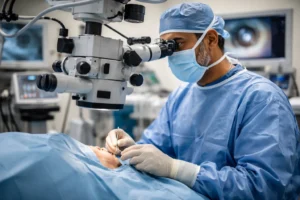
Cataract surgery is one of the most successful procedures performed today, restoring clear vision to millions of people each year. Whilst traditional cataract surgery replaces your cloudy natural lens with a standard monofocal lens, modern advances have introduced premium lens options during cataract surgery that can dramatically reduce or even eliminate your dependence on glasses. At The Eye Dr Clinic in West Yorkshire, Mr Mohamed Mohyudin, Consultant Ophthalmic Surgeon, offers a comprehensive range of advanced intraocular lenses (IOLs) tailored to your unique vision needs and lifestyle.
Understanding Intraocular Lenses (IOLs)
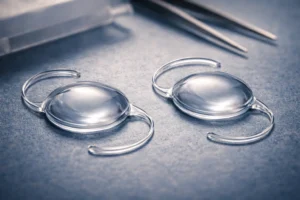
During cataract surgery, your cloudy natural lens is removed and replaced with an artificial lens called an intraocular lens (IOL). This clear, biocompatible implant becomes a permanent part of your eye, requiring no maintenance or care. Unlike the natural lens, an IOL will never develop cataracts and typically lasts a lifetime.
The type of IOL you choose significantly impacts your vision outcomes and quality of life after surgery. Whilst standard monofocal lenses provide excellent distance vision, they only focus at one fixed distance, meaning you’ll still need glasses for reading, computer work, or other near tasks. Premium lens options offer enhanced capabilities that can address multiple vision needs simultaneously.
Types of Premium Lens Options
Standard Monofocal Lenses
Before exploring premium options, it’s helpful to understand the baseline. Standard monofocal IOLs are designed to provide clear vision at one distance typically set for distance vision. They’re fully covered by the NHS and private insurance, making them the most economical choice.
Benefits:
Excellent distance vision, proven track record, no additional cost.
Limitations:
Require reading glasses for near tasks, cannot correct astigmatism, glasses needed for computer work.
Toric Lenses for Astigmatism Correction
If you have astigmatism an irregularly shaped cornea that causes blurred or distorted vision premium lens options during cataract surgery include toric IOLs. These specially designed lenses feature different powers in different meridians of the lens, compensating for the asymmetric curvature of your cornea.
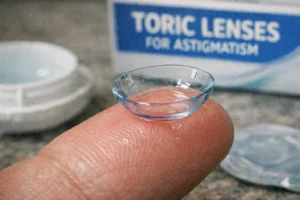
How Toric Lenses Work: During your pre-operative assessment, Mr Mohyudin takes precise measurements of your corneal curvature to determine the exact power and orientation needed. The toric lens is then carefully positioned during surgery to align with your astigmatism axis, correcting both the cataract and astigmatism simultaneously.
Benefits:
- Corrects moderate to severe astigmatism (up to 4.50 dioptres)
- Significantly sharper distance vision compared to standard lenses
- Reduces or eliminates the need for distance glasses
- High success rate with 94-98% achieving excellent astigmatism correction
Considerations:
Like monofocal lenses, toric lenses provide clear vision at one distance, so reading glasses are still typically needed. They require precise alignment during surgery and may rotate slightly during healing, though this is rare.
Ideal Candidates:
Patients with 1.0 dioptre or more of corneal astigmatism who want excellent distance vision with minimal dependence on glasses for everyday activities.
Multifocal and Trifocal Lenses
Multifocal IOLs represent a significant advancement in premium lens options during cataract surgery, offering clear vision at multiple distances near, intermediate, and far within a single lens. These lenses use advanced optical technology to split incoming light into different focal points, allowing you to see clearly whether you’re reading a book, using a computer, or driving.
How Multifocal Lenses Work:
The lens surface contains multiple zones with different optical powers. Your brain learns to automatically select the appropriate zone based on what you’re looking at, similar to how progressive glasses work.
Benefits:
- Clear vision at near, intermediate, and far distances
- Dramatic reduction or elimination of glasses dependence
- Freedom to perform daily activities without constantly reaching for glasses
- Permanent solution once adapted, the benefits last a lifetime
- Can be combined with toric correction for patients with astigmatism (multifocal toric lenses)
Considerations:
- There’s an adaptation period of several weeks to months as your brain learns to use the lens
- Some patients experience mild halos or glare around lights, particularly at night
- Not ideal for patients who drive extensively at night or require very precise near vision for professional tasks
- Higher cost compared to monofocal lenses
Ideal Candidates:
Active individuals who want freedom from glasses for most activities, are willing to adapt to the lens technology, and don’t have occupations requiring extensive night driving or extremely precise near vision tasks.
Extended Depth of Focus (EDOF) Lenses
EDOF lenses are among the newest premium lens options during cataract surgery, representing a middle ground between monofocal and multifocal lenses. Rather than creating distinct focal points, EDOF lenses elongate the range of focus, providing a continuous spectrum of clear vision.
How EDOF Lenses Work:
These lenses use innovative optical designs to extend the eye’s depth of focus, creating a smooth transition from distance to intermediate vision with some functional near vision.
Benefits:
- Excellent distance and intermediate vision (ideal for computer work, cooking, dashboard viewing)
- Significantly reduced halos and glare compared to multifocal lenses
- More natural vision transition between distances
- Good night vision with minimal visual disturbances
- Can be combined with toric correction for astigmatism
Considerations:
- Reading glasses may still be needed for prolonged reading or very fine print
- Near vision may not be as sharp as with multifocal lenses
- Premium pricing
Ideal Candidates:
Patients who prioritise natural vision quality, frequently use computers or tablets, drive regularly (including at night), and don’t mind using readers occasionally for extended reading sessions.
Choosing the Right Premium Lens Option
Selecting the best premium IOL involves considering multiple factors:
Your Lifestyle and Visual Demands
Active Lifestyle:
If you enjoy sports, travel, and outdoor activities, multifocal or EDOF lenses may offer the freedom you desire.
Professional Needs:
Computer professionals may benefit most from EDOF lenses with excellent intermediate vision. Surgeons or engineers requiring precise near vision might prefer monovision with monofocal or toric lenses.
Night Driving:
If you frequently drive at night, EDOF or toric monofocal lenses minimise halos and glare better than multifocal lenses.
Reading Habits:
Avid readers who spend hours with books may prefer multifocal lenses for sustained near vision.
Your Eye Health
Not all premium lenses are suitable for every patient. Certain eye conditions may limit your options:
- Advanced glaucoma or macular degeneration may preclude multifocal lenses
- Severe dry eye might affect lens performance
- Irregular corneas from previous surgery may benefit most from the Light Adjustable Lens
- Corneal conditions might affect toric lens stability
Your Expectations and Adaptability
Premium lenses work best for patients with realistic expectations who understand the adaptation process. If you’re willing to allow your brain time to adjust to new vision technology and can accept minor trade-offs (like occasional halos with multifocals), premium lenses offer remarkable benefits.
Financial Considerations
Premium lenses represent an additional investment beyond standard cataract surgery. Whilst NHS coverage or insurance typically covers the basic cataract procedure and standard monofocal lens, the upgrade to premium lens technology is the patient’s responsibility. However, many patients find the long-term benefits freedom from glasses, improved quality of life justify the initial cost.
The Consultation Process at The Eye Dr Clinic
Choosing premium lens options during cataract surgery is a collaborative process. During your comprehensive consultation with Mr Mohyudin, you’ll receive:
Thorough Eye Examination:
Advanced diagnostic testing to measure your eye precisely, including corneal topography, biometry, and optical coherence tomography.
Detailed Discussion:
Mr Mohyudin will review your daily activities, visual priorities, hobbies, and lifestyle to understand your needs.
Personalised Recommendations:
Based on your eye health, measurements, and lifestyle, he’ll recommend the most suitable lens options.
Clear Explanation:
You’ll receive detailed information about each lens type, including benefits, limitations, costs, and what to expect during recovery.
Opportunity for Questions:
We encourage questions and ensure you feel completely confident in your decision.
What to Expect After Premium Lens Implantation
Recovery from cataract surgery with premium lenses follows a similar timeline to standard surgery:
First 24 Hours:
Your vision will be blurry as your eye begins healing. Mild discomfort, light sensitivity, and watering are normal.
First Week:
Vision starts improving, though you may notice fluctuations. Follow all post-operative instructions carefully, including using prescribed eye drops.
First Month:
Vision continues stabilising. If you’ve received multifocal or EDOF lenses, your brain begins adapting to the new visual system.
Three to Six Months:
Full adaptation to premium lenses is typically complete. Most patients report high satisfaction with their vision and significant reduction in glasses dependence.
Why Choose The Eye Dr Clinic for Premium Lens Cataract Surgery?
Mr Mohamed Mohyudin (MBChB BSc MSc FRCOphth CCT) is a highly experienced Consultant Ophthalmic Surgeon specialising in advanced cataract surgery and premium IOL implantation. Registered with the General Medical Council, he combines technical expertise with a patient-focused approach.
At The Eye Dr Clinic, we offer:
- Access to the latest premium lens technologies
- State-of-the-art diagnostic equipment for precise measurements
- Personalised treatment plans tailored to your individual needs
- Comprehensive pre-operative assessment and post-operative care
- A supportive environment where your questions and concerns are addressed
Mr Mohyudin takes pride in helping patients achieve their best possible vision outcomes, whether that involves standard or premium lens options.
Frequently Asked Questions
Are premium lenses worth the extra cost?
For many patients, premium lenses offer life-changing benefits that justify the investment. The ability to see clearly at multiple distances without glasses, freedom to pursue hobbies and activities, and improved quality of life often outweigh the additional cost. However, the decision is highly personal and depends on your lifestyle, visual needs, and budget.
Can premium lenses be used in both eyes?
Yes, premium lenses are typically implanted in both eyes for optimal visual outcomes. Most surgeons perform cataract surgery on each eye separately, usually one to two weeks apart, allowing the first eye to heal before treating the second.
What if I’m not happy with my premium lens after surgery?
Whilst the vast majority of patients are very satisfied with premium lenses, adaptation takes time. Minor visual disturbances like halos usually diminish within weeks to months. If issues persist, options include glasses for specific tasks, laser enhancement procedures, or in rare cases, lens exchange. The Light Adjustable Lens offers unique flexibility by allowing adjustments after surgery.
Can premium lenses correct presbyopia?
Yes, multifocal and EDOF lenses are specifically designed to address presbyopia the age-related loss of near focusing ability. These lenses can restore your ability to read and perform close-up tasks without reading glasses, though results vary among individuals.
How long do premium intraocular lenses last?
Premium IOLs are designed to last a lifetime. Unlike the natural lens, they cannot develop cataracts and rarely require replacement. The lens becomes a permanent part of your eye, providing stable vision for decades. In the unlikely event of complications, lenses can be exchanged, but this is extremely rare.
Your Vision Matters to Us
Schedule your comprehensive eye examination today and discover how we can help you see the world more clearly.
The Eye Dr Clinic offers expert cataract surgery with comprehensive premium lens options at Spire Healthcare in Elland, Halifax. Mr Mohamed Mohyudin, our experienced Consultant Ophthalmic Surgeon, is dedicated to helping you achieve your best possible vision with advanced IOL technology tailored to your lifestyle. Contact us today to discuss your premium lens options and discover which solution is right for you.